
Concept Architecture
Linked Open Data Cloud and What It Shows
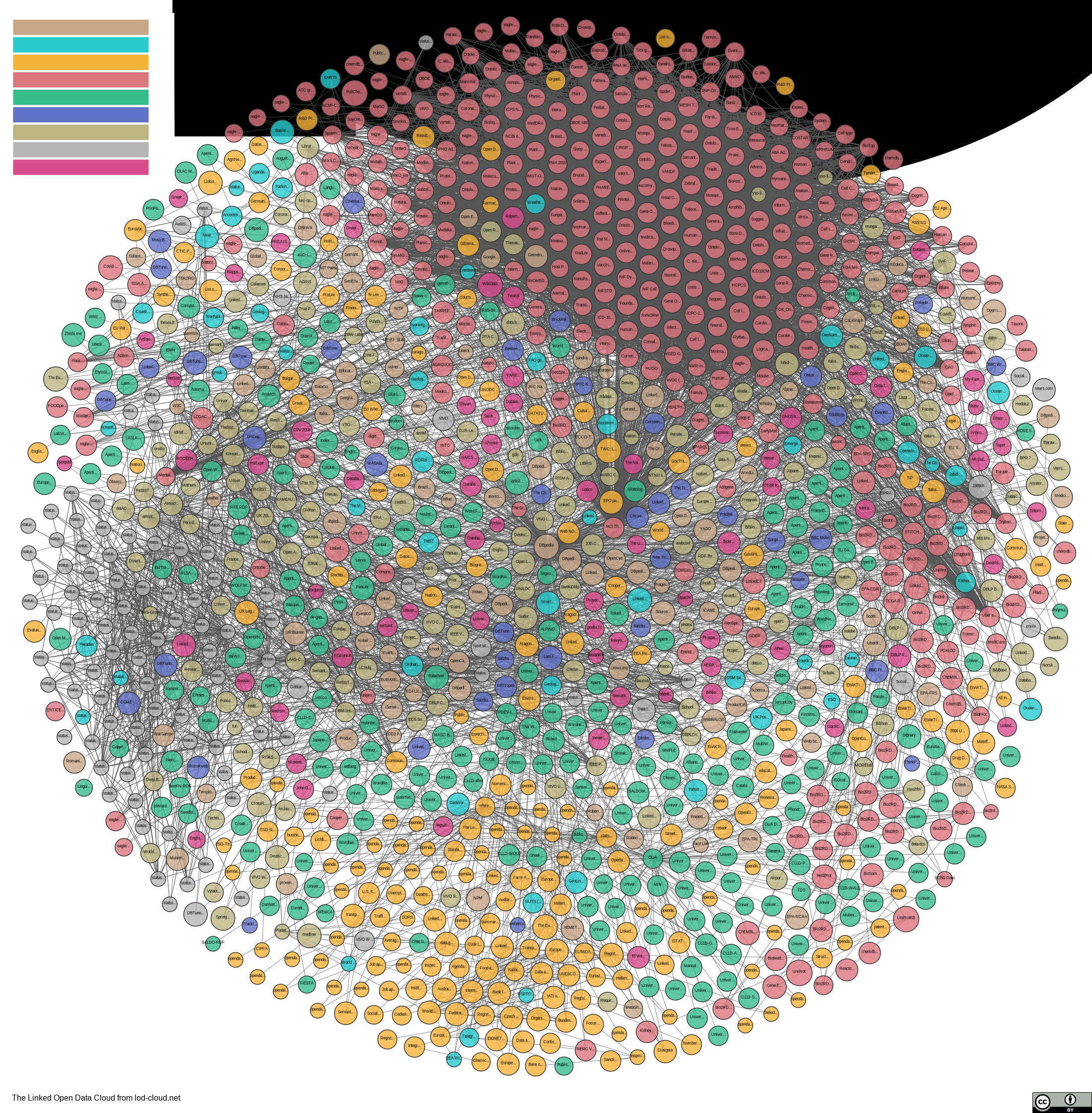
The Linked Open Data Cloud, usually shortened to LOD Cloud, is a picture of the catalogued part of the web of data. Each circle stands for a dataset published under the linked data practices, and each line shows that RDF links join items in two datasets. The diagram and the dataset records behind it are kept at lod-cloud.net, where the latest version, dated 15 June 2026, listed 1,360 datasets when read on 20 November 2026. For health economists it is a rough guide to which open vocabularies and life sciences datasets are already joined up, and a place in the cloud says little about licence, quality or upkeep.
Who uses the name and what it refers to
The name comes from web publishing, with no separate health economics sense. The site lod-cloud.net calls itself The Linked Open Data Cloud and its image the LOD cloud diagram. John P. McCrae maintains the diagram for the Insight Centre for Data Analytics, and the site names Richard Cyganiak and Anja Jentzsch among earlier maintainers or helpers.
Bizer, Heath and Berners-Lee wrote in 2009 of the Linking Open Data cloud diagram, an overview of the datasets that grew out of the Linking Open Data project. They describe that project as a grassroots community effort founded in January 2007 and supported by the W3C Semantic Web Education and Outreach Group. Allemang, Hendler and Gandon reproduce a chart of dataset counts taken from lod-cloud.net in the section of Semantic Web for the Working Ontologist on distributed data. The wiki's label matches the site's own title and the caption of Figure 1.1 in the book, while older writing says Linking Open Data cloud after the project.
How the diagram is drawn and which datasets get in
In the account of Bizer and colleagues, each node is a distinct dataset published as linked data, an arc means that links exist between items in the two datasets, and heavier arcs roughly mark more links. Colours sort the datasets by topical domain, and lod-cloud.net offers separate subclouds for nine domains, among them Life Sciences, Government and Publications.
Entry depends on rules that the site derives from the linked data principles. A dataset needs resolvable http or https addresses that return RDF in a popular format such as Turtle or RDF/XML, it must hold at least 1,000 triples, and it must have at least 50 RDF links to a dataset already in the diagram, a threshold the site itself calls arbitrary. The whole dataset must also be reachable by crawling, through a downloadable dump or through a SPARQL endpoint.
Growth recorded in the dated versions
The site keeps each dated version of the diagram with its dataset count, a record of how linked data publishing spread. Counts rose quickly in the early years and have grown slowly since 2020.
| Version date | Datasets in the diagram |
|---|---|
| 1 May 2007 | 12 |
| 22 September 2010 | 203 |
| 19 September 2011 | 295 |
| 30 August 2014 | 570 |
| 22 August 2017 | 1,163 |
| 20 May 2020 | 1,255 |
| 15 June 2026 | 1,360 |
The count rose by 1,163 − 570 = 593 datasets between the 2014 and 2017 versions shown, and by 1,360 − 1,255 = 105 between the 2020 and 2026 versions.
The counts were not all built the same way, so a slower rise is weak evidence about how much linked data is published. The 2011 State of the LOD Cloud report by Jentzsch, Cyganiak and Bizer drew its statistics from the dataset catalogue that publishers filled in on CKAN. The 2014 report by Schmachtenberg, Bizer and Paulheim rested instead on a crawl of the web in April 2014, which found 1,014 linked datasets, of which 56.11% linked to at least one other dataset, against 570 in the diagram dated 30 August 2014. Berners-Lee notes that much linked data is used inside organisations, and such data never appears in the cloud.
Health and life sciences data in the cloud
Life sciences have formed a large part of the cloud since at least 2010. In Heath and Bizer's figures for November 2010, 42 of the 203 datasets were in life sciences, and they set 50.67% of all outgoing RDF links. The 2011 report counted 41 of 295 datasets in life sciences, with 38.06% of outgoing links. Heath and Bizer give the Bio2RDF project as an example of this uptake, since it interlinked more than 30 widely used datasets, PubMed and the Gene Ontology among them.
In the dataset file behind the 15 June 2026 version, Life Sciences is the largest of the nine domains, with 383 dataset records. They include Bio2RDF versions of DrugBank and of the ClinicalTrials.gov registry, and records titled SNOMED Clinical Terms and ICD10, neither of which names a licence. The diagram of that version also draws two drug price datasets, a list of maximum prices of reimbursed medicinal products in the Czech Republic and drug data with reference prices from the Health Insurance Fund of Macedonia, whose dates and upkeep would need checking at source before use in a model.
Using the cloud in health economics work
For a modeller the cloud is a starting list of identifier sources that other datasets already use. Coding a model's resource-use items or outcomes to addresses in a well-linked dataset makes the inputs easier to match with other people's data, the aim of the practices on the Linked Data (Semantic Web) page.
The Health Economics Ontology (HEO), published by Intelligent Parameters Ltd at healtheconomics.wiki/ontologies/heo, gives a real case. Its version 2.0.0, released as OWL and Turtle files under a CC BY 4.0 licence, carries 602 SKOS exact-match links to Wikidata items, and Wikidata is drawn as a node in the diagram of the 15 June 2026 version. That number clears the 50-link threshold. HEO is not among those datasets, and a submission would also be tested on whether its addresses return RDF in a listed format and whether the whole dataset can be reached.
Worked example screening a unit cost vocabulary (illustrative)
A national costing team publishes its schedule of unit costs as a linked data vocabulary and checks it against the lod-cloud.net rules. All figures are illustrative.
1. Count the triples. The vocabulary holds 240 cost items, each described by 9 RDF statements such as its unit and price year, so it holds 240 × 9 = 2,160 triples, above the minimum of 1,000.
2. Count the links into the diagram. Of the 240 items, 150 carry a link to the procedure or service concept they cost in a clinical terminology that is already in the diagram, which clears the threshold of 50 links.
where is the share of cost items linked into the diagram, is the number of items with such a link, and is the number of cost items. Here = 150 / 240 = 0.625, so 62.5% of the items are linked and 240 − 150 = 90 are not.
3. Check access. The item addresses return Turtle and a full dump can be downloaded, which meets the access rules.
4. Check the licence. The team releases the vocabulary under a non-commercial licence. The cloud's rules say nothing about licences, so the vocabulary could still appear in the diagram. The Open Definition requires a licence to allow use for any purpose, so the data would not count as open under it. Berners-Lee asks for a licence that does not impede reuse for free, and the examples he gives are CC BY and the UK Open Government Licence.
A place in the cloud would tell reviewers in a health technology assessment that the schedule is linked and machine-readable. It would not show that the prices are right, and the 90 unlinked items would still need coding.
How the cloud differs from neighbouring ideas
The cloud is a depiction and a catalogue, while Linked Open Data is the data it sets out to depict, linked data released under an open licence. The web of data is the wider space of linked datasets, and the cloud shows the part that has been catalogued and meets the entry rules. A knowledge graph may be private, and an organisation's graph can reuse addresses from datasets in the cloud without appearing there itself. A dataset must return data in the Resource Description Framework to enter the diagram.
Limits and common misreadings
The word open in the name is not checked. The entry rules do not mention a licence, and the 2011 report found that 43 of the 295 datasets gave licensing information, with 1 of 41 in life sciences. The 2014 report found licensing information in RDF for 7.85% of crawled datasets. In the dataset file for the 15 June 2026 version, 93 records name a Creative Commons non-commercial licence, which fails the any purpose test of the Open Definition.
A node is not a mark of quality. Bizer, Heath and Berners-Lee list trust, quality and relevance among the research challenges for linked data, so a dataset drawn in the cloud still needs the checks any model input receives before it is used in a cost-effectiveness analysis.
Sources
- McCrae JP, maintainer. The Linked Open Data Cloud. Insight Centre for Data Analytics. Home page, diagram and dataset records of the version of 15 June 2026, accessed 20 November 2026. https://lod-cloud.net/, https://lod-cloud.net/versions/2026-06-15/lod-cloud.svg and https://lod-cloud.net/versions/2026-06-15/lod-data.json
- Bizer C, Heath T, Berners-Lee T. Linked Data: the story so far. International Journal on Semantic Web and Information Systems. 2009;5(3):1-22. https://doi.org/10.4018/jswis.2009081901
- Heath T, Bizer C. Linked Data: Evolving the Web into a Global Data Space. Synthesis Lectures on the Semantic Web: Theory and Technology. Morgan and Claypool; 2011. https://doi.org/10.2200/S00334ED1V01Y201102WBE001
- Jentzsch A, Cyganiak R, Bizer C. State of the LOD Cloud. Version 0.3, 19 September 2011. Archived copy of 28 December 2014. https://web.archive.org/web/20141228201447/http://lod-cloud.net/state/
- Schmachtenberg M, Bizer C, Paulheim H. State of the LOD Cloud 2014. Version 0.4, 30 August 2014. http://linkeddatacatalog.dws.informatik.uni-mannheim.de/state/
- Berners-Lee T. Linked Data. Design Issues, W3C. 27 July 2006, five star section added 2010. https://www.w3.org/DesignIssues/LinkedData.html
- Open Knowledge Foundation. Open Definition 2.1. November 2015. https://opendefinition.org/od/2.1/en/
- Allemang D, Hendler J, Gandon F. Semantic Web for the Working Ontologist. 3rd edition. ACM Books; 2020. Chapter 1.
Related Concepts (2)
Frequently Asked Questions (6)
What is Linked Open Data Cloud?
The Linked Open Data Cloud is a diagram of datasets published as linked data and the links between them, from a project begun in 2007.
Source: Bizer et al. 2009
How does a dataset get into the Linked Open Data Cloud?
Entry to the Linked Open Data Cloud depends on rules that lod-cloud.net derives from the linked data principles. Its http or https addresses must resolve to RDF in a popular format such as Turtle or RDF/XML, and it must hold at least 1,000 triples. It also needs at least 50 RDF links to a dataset already in the diagram, a threshold the site itself calls arbitrary. The whole dataset must be reachable by crawling, through a downloadable dump or through a SPARQL endpoint. The rules do not ask about a licence.
Source: McCrae 2026
How has the Linked Open Data Cloud grown since 2007?
The Linked Open Data Cloud has grown from 12 datasets in its version of 1 May 2007 to 1,360 datasets in its version of 15 June 2026, according to the history table at lod-cloud.net. Growth was fastest in proportion in the early years, with 203 datasets by September 2010 and 295 by September 2011, while the largest rise between the versions shown came from 570 in August 2014 to 1,163 in August 2017. Between the versions of May 2020 and June 2026 the count rose by only 105. The counts were not all built the same way, so the slower rise says little on its own about how much linked data is published.
Source: McCrae 2026
What health and life sciences data appear in the Linked Open Data Cloud?
Life sciences have formed a large share of the Linked Open Data Cloud since at least 2010. Heath and Bizer report that in November 2010 there were 42 life sciences datasets among 203, and that they set 50.67% of all outgoing RDF links in the cloud. They give the Bio2RDF project as an example, since it interlinked more than 30 widely used datasets, PubMed and the Gene Ontology among them. For a health economist this makes biomedical identifiers one of the better linked parts of the cloud, though each dataset still needs its licence and quality checked.
Source: Heath and Bizer 2011
Does a place in the Linked Open Data Cloud mean that a dataset is openly licensed?
The entry rules at lod-cloud.net do not ask about licences, so a place in the Linked Open Data Cloud says nothing about whether a dataset carries an open licence, despite the word open in its name. The 2011 State of the LOD Cloud report found that only 43 of the 295 datasets in the cloud gave licensing information, and in life sciences only 1 of 41 did. A health economist reusing such data should therefore check the licence of each source directly.
Source: Jentzsch et al. 2011
How can health economists use the Linked Open Data Cloud when building models?
Health economists can use the Linked Open Data Cloud as a starting list of datasets whose web addresses are already reused by others, for example when choosing identifiers for resource-use items or outcomes in a model. Coding inputs to well-linked addresses makes them easier to match with other people's data. A dataset drawn in the cloud is not checked for accuracy, and Bizer, Heath and Berners-Lee list trust, quality and relevance among the research challenges for linked data. Each source still needs the usual checks before its values enter an economic evaluation.
Source: Bizer et al. 2009
Trust Record
Verified by Dr Darrin Baines
British health economist
Professional identity: darrinbaines.org
Verification date: 21 Nov 2026
Content version: 1.0.1
Canonical Identity
- Term code
- HS-HP-DH-153
Stable URI · Machine-readable · Resolvable · CC BY 4.0